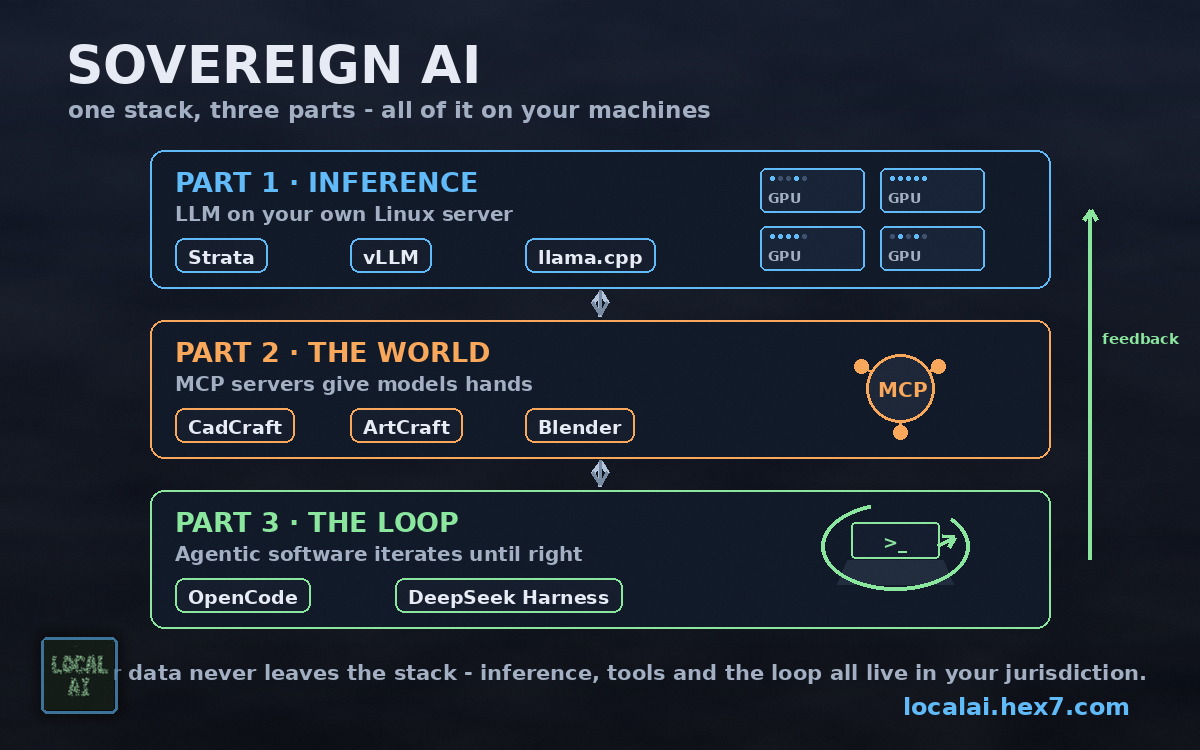
Every machine-learning system that actually produces work has the same three parts. Cloud vendors sell them fused together and call the bundle a platform. Untangle the bundle and you get a stack you can own outright, part by part, on machines you already control.
Part 1 – Inference: an LLM on your own Linux server
The first part is the model itself, running where you decide it runs: a Linux server with a GPU in your own rack. Strata serves weights straight from local NVMe, vLLM batches requests for throughput, llama.cpp runs the same weights portably across consumer cards. Nothing about the model requires a vendor’s datacenter; the only reason inference happens somewhere else is that someone else’s machine was nearby and metered.
Put inference on your server and the data plane never moves. The prompt goes in one network cable, the completion comes back the same way. No subprocessor chain, no third-country transfer assessment, no standard contractual clauses to sign – because no transfer occurs.
Part 2 – The world: MCP servers give the model hands
A bare model can talk but cannot act. The second part is a set of small local processes that let it touch real work, wired through the Model Context Protocol (MCP). Each server exposes one narrow capability as typed tools:
- CadCraft drafts and revises DWG sheets – floor plans, elevations, sections, schedules.
- ArtCraft handles raster artwork and batch image work.
- Blender connects the model to a live 3D scene – geometry, materials, camera.
- Filesystem, database and search servers extend the same pattern to the rest.
Because every action passes through a named tool on a named process, the log writes itself: which tool was called, with what arguments, what came back. That audit trail is the difference between a demo and a production pipeline.
Part 3 – The loop: an agent on a laptop iterates until the result is right
The third part is agentic software on a laptop – macOS or Linux – that plans work, calls the model for reasoning and the MCP servers for actions, inspects what came back, and repeats. OpenCode drives this loop for code and documents; DeepSeek Harness structures it for long tasks that need checkpoints.
The loop is the quality mechanism. A single pass from any model is a draft. Drafting, checking dimensions, catching the mismatch, redrafting – the agent does that round trip as many times as the work demands, and each round trip spends local GPU cycles, not someone’s metered request quota.
The three parts form one stool
| Part | Lives on | Does |
|---|---|---|
| 1. Inference | Linux server | reason (Strata, vLLM, llama.cpp) |
| 2. MCP servers | same network | act on the world (CadCraft, ArtCraft, Blender) |
| 3. Agent loop | your laptop | iterate to a correct result (OpenCode, DeepSeek Harness) |
Remove any one leg and you are renting it from somebody else. An agent laptop that calls a cloud API for inference has leaked its prompts into another jurisdiction. A cloud inference service with no local tools is a chatbot. A tool server nobody orchestrates sits idle.
That matters for the same reason it always has: customer data on GOOGLE or MICROSOFT sits under the US CLOUD ACT, regardless of which datacenter the bytes live in. A stack built from these three parts answers the jurisdiction question with a floor plan. Inference, tools and the loop all sit inside the Perpinyà – Girona – Barcelona corridor, under GDPR, in your building.
Building it
Private Local AI assembles all three parts on your hardware: model serving tuned to your cards, MCP servers for your actual workflows, and the agent harness wired to both. Ask about an on-site assessment: privatelocalai@proton.me.
Leave a Reply